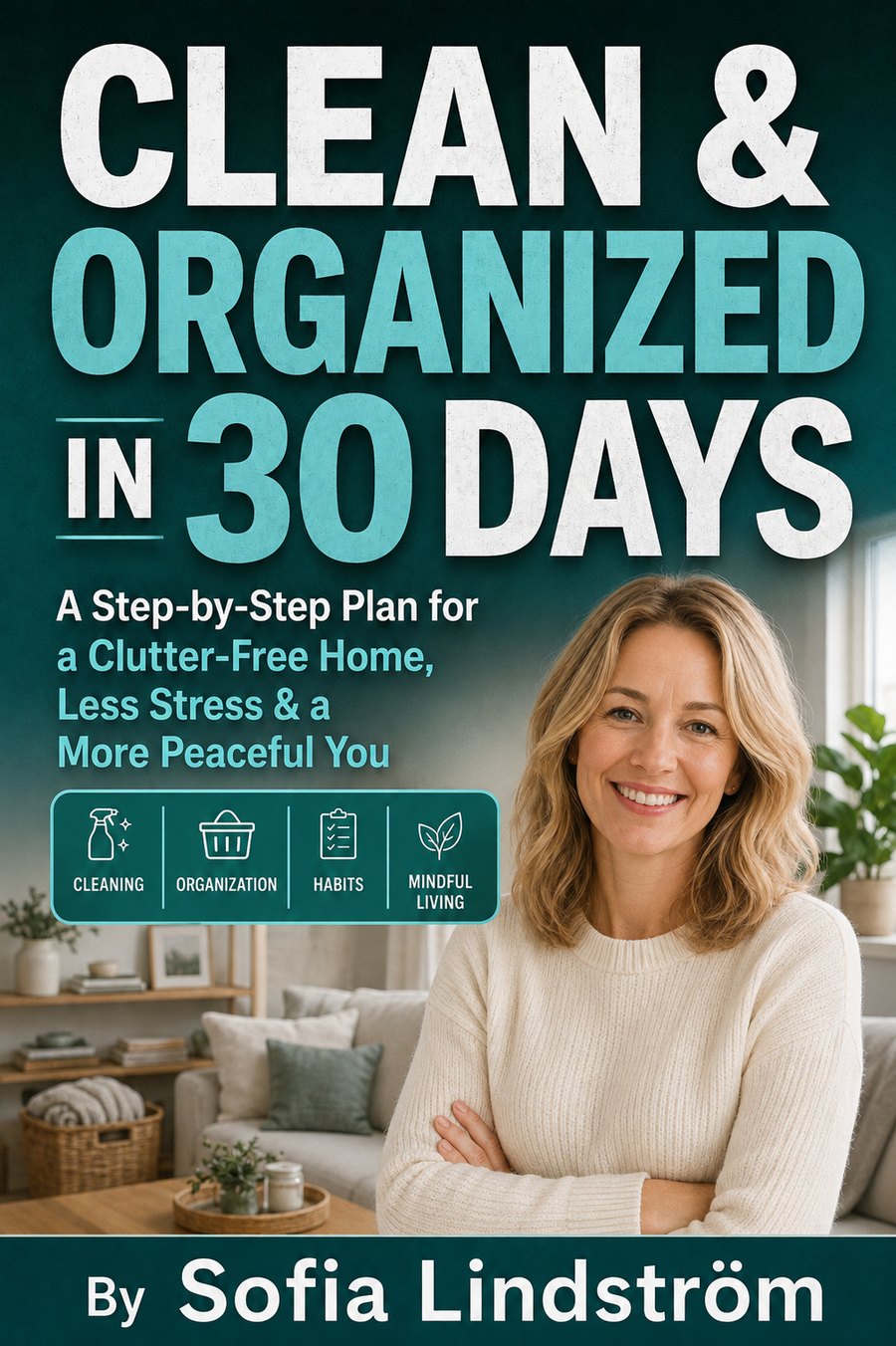
Shoes at the door. The ten-minute evening reset. One in, one out. Two-ingredient cleaning. The light rules. A home for everything. Get those six right in your first week, and the house you've been buying bins and gadgets to fix starts fixing itself.
Skip the $900-a-year organizing-aisle guessing game.
Do what Scandinavian households actually do — in 30 days, in plain English, one job per day.
Studio apartment or four-bedroom house with a garage — the plan adjusts to the home you actually have. You don't have to be a minimalist, and you don't throw away things you love. Day 1 is a walk through your own rooms with a notebook. From there, the book gives you the exact 30-day sequence for your situation.
The most powerful part of this book is not a folding technique. It is the moment you see the organizing-aisle math. The bins, the caddies, the miracle sprays, the duplicate purchases for things you own but cannot find — that is what turns an ordinary home into a recurring annual bill.
The Nordic Home Reset shows the Scandinavian version of the same logic: what leaves first, what stays, what two ingredients clean nearly everything, and when buying a container actually makes sense.
Example math from the book's home-math chapter for a typical family household. Your home size, habits, and local prices may differ.
“The home-math chapter is genuinely the angriest I've been at a store aisle in years. I went through twelve months of receipts like the book says: $460 on bins and organizers, and — this is the embarrassing one — $270 on things I already owned and couldn't find. Phone chargers. A tape measure. Three pairs of scissors. The book's rule is that clutter costs money twice: once when you buy it, once when it hides what you need. One month of the outflow plan and I found four of the things I'd re-bought. In my own house.”
The first Scandinavian home I ever stayed in belonged to a family of five outside Bergen. Two working parents, three kids — and the house was guest-ready at all times. Not showroom-sterile. Calm. I assumed a cleaner came twice a week. There was no cleaner. There was a rhythm.
What I eventually understood — and what the Nordic Genius channel exists to share — is that Scandinavian homes don't stay clean because the people work harder. They stay clean because the systems are older than the clutter industry: fewer things, each with a home, ten minutes of reset a day, two cleaning ingredients instead of twelve bottles, and light treated as furniture.
This book is that system, sequenced for a real household in 30 days. Everything from the channel — and plenty that's never been in a video — in one document you can act on tonight.
It is not written like a design magazine. It is written like a checklist for the person who wants the house to finally stop being a second job.
It is owning more than the home can hold — then buying containers to manage the overflow.
“I bought it because my neighbor Astrid's house always looks effortlessly done and mine looked like a donation center with a mortgage. I'm 51, I've been ‘getting organized’ for nine years, and I had no idea I was doing it backwards — organizing first, decluttering never. The book's line that stopped me: you can't organize your way out of owning too much. Day 1 was just walking my own house with a notebook and I found three ‘clutter reservoirs’ I'd stopped seeing entirely. A month in, my kitchen counter is still clear. My actual kitchen counter.”
The first seven days cost nothing and buy the information everything else depends on. Before you buy another bin, the book walks you through the seven observations that determine whether the rest of the month works.
Shoes at the door. A home for every object. Ten minutes of evening reset. Two cleaning ingredients. Those are not glamorous, but they are the reason two identical houses on the same street can feel completely different inside.
That is why the book dedicates a full part to room-by-room systems — and separates the advice for small rentals from the advice for family houses with garages. The organizing aisle sells both households the same bins. This book doesn't.
“Two specific things from the cleaning chapters. One: I owned eleven cleaning products and the book's label-reading exercise showed me eight of them were the same two ingredients in different bottles at 10x the price. I clean the whole house now with dish soap, white vinegar, and a pine soap I ordered after the Scandinavian-soap section — total cost maybe $20 a year. Two: my ‘I hate cleaning’ problem was actually an ‘everything takes 40 minutes of moving stuff first’ problem. Clear surfaces made cleaning a ten-minute job, and ten-minute jobs actually happen.”
“Honestly, on Day 4 I thought I'd wasted my $28. The evening-reset chapter felt like something I already knew. Then I actually timed my old way: we ‘cleaned when it got bad,’ which meant 3-hour weekend marathons everyone dreaded and a messy house the other six days. The ten-minute reset — everyone, every evening, music on — sounded like a fantasy with two kids. It took four days to become automatic because the book has you do it AFTER the outflow week, when there's finally less stuff than homes for it. First month in eight years I didn't lose a Saturday to the house.”
The complete PDF book is delivered after checkout. Read it on your phone, tablet or laptop — or print the checklist pages and put them to work inside your cupboard doors tonight.
“I'm 67 and downsizing after my husband passed — forty years of a shared life in one house, and I could not face any of it. A friend sent me this book for the Swedish death-cleaning chapter, which sounds morbid and is actually the kindest thing I've read about belongings: you handle each thing once, you keep what carries love, and you stop leaving the weight for someone else. The 30-day sequence gave me something no grief book did — one small job a day, in order, with a reason. My granddaughter helped me with the photo boxes. The house isn't done. But I open every door in it now.”
Verified reader reviews are included as provided for publication. Names, wording, and identifying details may be edited for privacy and clarity. Outcomes vary by household size, habits, and how fully the plan is applied.
Keep handing $900 a year to the organizing aisle that will not even tell you why the counter refills itself every week.
Keep buying bins, sprays and weekend guilt forever.
Use one clear plan. Map the house, run the outflow, set the entryway rule, learn the two-ingredient method, build the ten-minute rhythm and let the light do the decorating.
Once you learn your home, nobody can sell you bins for it again.
By clicking you agree to our Terms of Service and Privacy Policy. This is educational home-organization content. Results vary by household. By completing a purchase you consent to immediate delivery of digital content.